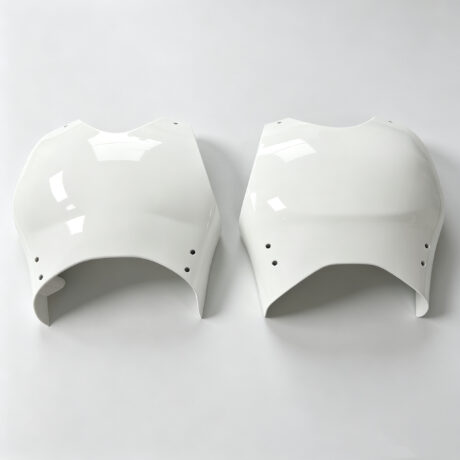

Project Case: High-Gloss White Robot Outer Cover (Silicone Vacuum Casting)
1. Project Overview
This curved exterior cover is a cosmetic part for service robots. At the prototype and low-volume trial stage, the client needed high-fidelity finished parts without high upfront injection mold costs.
We adopted silicone vacuum casting (urethane casting) process to produce the components, delivering parts with precise geometry and high-gloss painted finish for assembly verification and small-batch trial marketing.
2. Core Technical Challenges
- Large continuous curved A-class surface, requiring smooth surface reproduction from the master pattern, no visible parting lines, bubbles or sink marks.
- Consistent positioning accuracy of mounting holes to ensure assembly compatibility.
- Achieving uniform high-gloss white coating finish on cast resin material, stable paint adhesion.
- Short lead time to support rapid robot prototype iteration.
3. Our Manufacturing Solution
3.1 Master Pattern & Silicone Mold Fabrication
3.2 Vacuum Casting Process
3.3 Post Processing
3.4 Surface Finishing
3.5 Quality Inspection
4. Project Outcomes
✅ Successfully produced low-volume robot covers with accurate curved geometry, fully matching design specifications
✅ High-gloss white cosmetic surface meets the client’s aesthetic standard for robot prototype display
✅ Avoided expensive hard tooling investment for trial phase; shortened the whole prototype delivery cycle
✅ Verified assembly performance, providing reliable samples for robot function testing and market evaluation
Conclusion