
Case Study of Film Coating for Coffee Grinder Housing by Jili Company
1. Project Background
In the coffee utensil market, consumers increasingly value not only good functionality but also the texture and durability of the appearance. Leveraging its professional advantages in CNC machining, Jili Company has undertaken a project to apply film coating to the housing of a coffee grinder for a well – known coffee utensil brand. The brand aims to enhance the appearance quality, scratch – and – wear resistance of the grinder housing through the film – coating process, thereby strengthening the product’s competitiveness in the market.
2. Product Analysis
2.1 Structural Features of the Grinder Housing
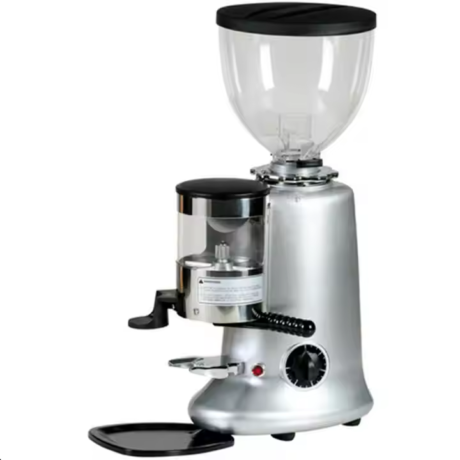
The housing of this coffee grinder (as shown in the figure) is mainly made of aluminum alloy and consists of components such as the base, the main body, and the hopper – connecting part. The base needs to have a certain weight and stability to ensure the smooth operation of the grinder during working. The main body has installation positions for control knobs, switches, etc., and its surface has various curves and turns, increasing the processing difficulty. The hopper – connecting part must ensure a tight connection and good appearance with the transparent hopper.
2.2 Film – Coating Requirements
The customer requires a PET film with a metallic texture in silver – gray, which matches the simple and modern design style of the grinder. The film should not only fit perfectly with the complex curved surface of the housing but also have excellent scratch – resistance, ensuring no easy scratches during daily use. Meanwhile, it should not blister or peel off under certain temperature and humidity conditions.
3. Jili Company’s Processing Flow
3.1 Pre – processing Preparation
- Design Communication and Confirmation
- Have in – depth communication with the customer to obtain the detailed 3D design model of the coffee grinder housing and specific film – coating requirements, such as the film thickness (0.15mm) and glossiness (reaching 90% mirror effect).
- Organize internal design and process teams to discuss and develop an initial processing plan, and repeatedly confirm details with the customer to ensure the plan meets their needs.
- Material Procurement and Inspection
- Purchase high – quality silver – gray PET film materials and conduct strict quality inspections. The inspection items include tensile strength (required to be ≥150MPa), peel strength (peel strength with the aluminum alloy substrate ≥10N/cm), and temperature resistance (stable performance at – 20℃ – 60℃), ensuring the materials meet processing and usage requirements. At the same time, prepare aluminum alloy blanks for CNC processing and conduct inspections on hardness, purity, etc.
3.2 CNC Machining
- Rough Machining of the Housing
- Use a five – axis CNC machining center to rough – machine the aluminum alloy blank. According to the design model, quickly remove most of the excess material to initially form the shape of the grinder housing. During processing, optimize the tool path and use a layered cutting method to reduce the impact of cutting force on the workpiece and prevent deformation. Select cemented carbide tools and set appropriate cutting parameters, such as a spindle speed of 8000r/min, a feed rate of 800mm/min, and a cutting depth of 1.5mm.
- Finish Machining of the Housing
- After rough machining, perform finish machining. Replace with a high – precision milling cutter to finely machine detailed parts such as the curves and installation positions on the main body, ensuring the dimensional accuracy is controlled within ±0.03mm. For the part connected to the hopper, use a combination of boring and milling methods to ensure the dimensional accuracy of the connection part for a tight fit with the hopper. Meanwhile, machine the flatness of the base, ensuring the flatness error does not exceed 0.02mm to ensure the stability of the grinder during placement.
- Surface Treatment
- After finish machining, perform surface treatment on the housing. First, use a sandblasting process to form a uniform and fine rough texture on the housing surface to increase the adhesion between the film and the housing. The sandblasting uses alumina sand with a particle size of 0.2 – 0.3mm and a sandblasting pressure controlled at 0.4 – 0.5MPa. After sandblasting, clean and dry the workpiece to remove surface impurities and moisture.
3.3 Film – Coating Workflow
1. Pre – coating Prep
- Preheated the housing (40℃) in a dust – free room for better film bonding.
- Cut PET film 5mm larger than the housing for edge wrapping.
2. Hot – Press Coating
- Applied the film via hot pressing: Temperature 120–130℃, pressure 0.8MPa, speed 30mm/min.
- Rolled the film to remove air (preventing bubbles) and manually adjusted for curves/angles.
3. Edge Trimming & Sealing
- Trimmed excess film and wrapped edges to the housing back for a neat, durable finish.
- Inspected for defects (e.g., bubbles) and used pinhole /heating to fix issues.
3.4 Quality Control
- Appearance Check: Inspected for smoothness, uniform gloss, and edge neatness under natural light.
- Dimensional Testing: Used a CMM to verify mount/connector tolerances.
- Performance Tests:
- Scratch Resistance: Tested with an H2 pencil (500g force, 45° angle—no visible scratches).
- Environmental Stability: Exposed to -20℃ (12h) and 60℃/90% humidity (24h)—no peeling/blistering.
4. Challenges & Solutions
4.1 Complex Curve Adhesion
Issue: Film wrinkling/bubbling on curved surfaces.
Solution: Used 3D scanning to map contours, simulated the coating process, and pre – heated/pressed curves before full coating.
Solution: Used 3D scanning to map contours, simulated the coating process, and pre – heated/pressed curves before full coating.
4.2 Film Durability
Issue: Potential peeling due to smooth aluminum.
Solution: Sandblasted the housing and applied a primer to boost adhesion; sealed edges with a special adhesive.
Solution: Sandblasted the housing and applied a primer to boost adhesion; sealed edges with a special adhesive.
5. Project Outcomes
5.1 Client Feedback
The client praised the finished grinders: The film – coated housing met design goals, with a premium metallic look and proven durability. Field tests showed no film damage after extensive use, improving the product’s market appeal.
5.2 Jili’s Growth
This project refined Jili’s film – coating + CNC process for complex parts. It strengthened our quality management system and positioned us as a leader in high – end CNC machining—ready for future projects in automotive, electronics, and beyond.