
High‑Precision CNC 5‑Axis for Humanoid Robot Joint Housings
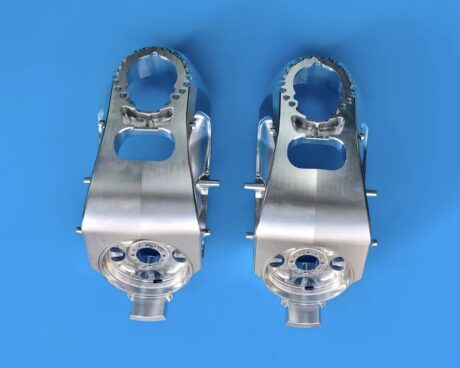
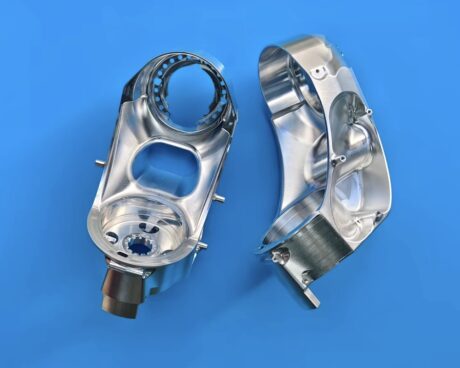
These intricate aluminum joint housings are core mechanical components for humanoid robots, responsible for connecting robot arm and torso joint modules. Complex free‑form curved surfaces, multi‑direction mounting holes, positioning pins, bearing seats and gear‑matching cavities are integrated within one single part, which cannot be completed by conventional 3‑axis CNC equipment. The full production workflow covers material preparation, multi‑stage CNC machining, manual deburring, surface finishing, precision metrology inspection and final quality confirmation.
1. Raw Material Preparation
High‑strength aluminum alloy billets are selected as base material. Before machining, material hardness and internal texture will be inspected to avoid internal porosity or material defects. Raw blocks are cut into rough blanks slightly larger than final part dimension, reserving proper machining allowance for subsequent multi‑pass milling.
2. Multi‑Setup 5‑Axis CNC Rough Machining
Blanks are clamped onto 5‑axis CNC machining centers. The first phase is rough milling: large volume of excess material is rapidly removed. Roughing leaves uniform stock on curved surfaces, inner cavities and mating features. Multiple clamping orientations are required, as these robot joint parts have inner undercuts and multi‑angle features that need the 5‑axis rotary table to swing spindle into every hard‑to‑reach internal area. At this stage, major outer contours, hollow cavities and preliminary hole positions take shape.
3. Finishing Machining for Critical Functional Features
After roughing, semi‑finishing and full finishing cycles start. This is the most critical step for robot joint performance. Bearing seats, gear fitting bores, positioning pin holes, threaded mounting bosses and mating contact surfaces are machined to tight tolerance requirements. Every curved profile that contacts robot internal drive components is milled with fine step‑over to achieve smooth continuous geometry. Tiny clearance for rotating movement is strictly controlled; even micron‑level deviation will cause joint jitter, abnormal noise or assembly failure in the final robot unit. Multiple tool changes are applied: flat end mills for cavities, ball nose cutters for complex curved surfaces, tapping tools for threaded holes.
4. Post‑Machining Manual Deburr & Surface Treatment
After CNC cutting, sharp burrs remain on hole edges, thread openings and intersecting surface corners. Technicians perform careful manual deburring without damaging finished functional surfaces. Parts go through cleaning to fully remove cutting oil, aluminum chips and residual contaminants. For these display‑grade robot housings, polishing is carried out to obtain the bright metallic surface seen in the photo, improving appearance while eliminating stress concentration points on sharp edges.
5. Comprehensive Dimensional & Geometric Inspection
Every finished component enters the quality‑control workshop. A coordinate measuring machine (CMM) is used to scan complex 3D contours, verifying hole position accuracy, flatness, concentricity of bearing seats and overall part geometry. Pin gauges and thread gauges check holes and threads. Key dimensional data is recorded for traceability. Any part out of tolerance will be rejected. Our complete set of measuring instruments ensures each joint housing meets humanoid robot mechanical design specifications.
6. Final Cleaning & Delivery Preparation
Qualified parts receive final ultrasonic cleaning to eliminate fine metal particles. Components are individually packaged to prevent surface scratches during transit. These CNC‑manufactured robot joint housings are ready for prototype assembly testing and small‑batch production, supporting R&D iteration of next‑generation humanoid robotic systems.